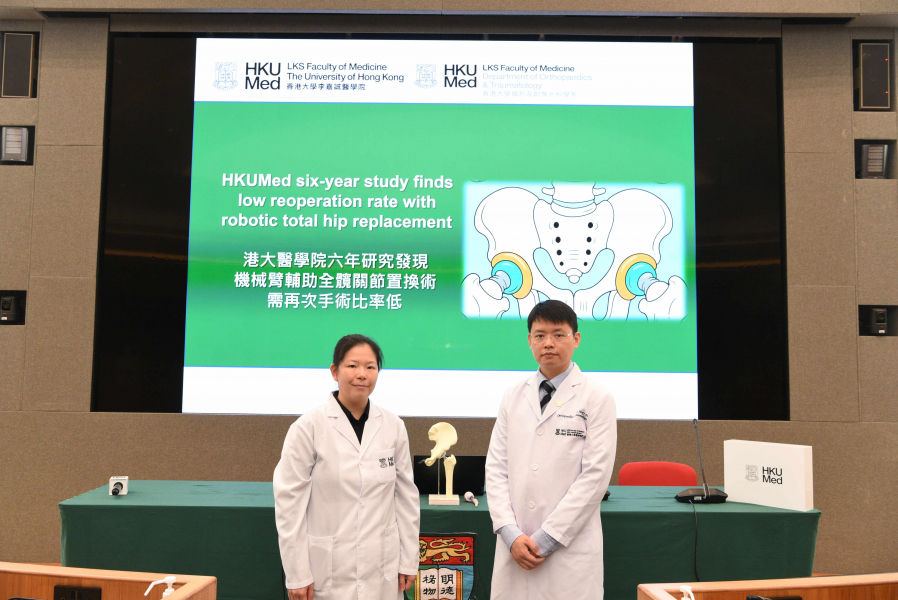
A research team from the Department of Orthopaedics and Traumatology, School of Clinical Medicine, LKS Faculty of Medicine of the University of Hong Kong (HKUMed), has demonstrated that robotic total hip replacement has a lower reoperation rate than the conventional technique. The study found a 90-day reoperation rate of only 0.6% with robotic procedures as compared to 2.5% with conventional procedures. Robotic procedures thus promise long-term benefits for patients, enabling them to regain mobility and return to normal life.
End-stage hip arthritis causes severe groin pain, joint stiffness and functional deficit, including impairment in walking, sitting and standing. While total hip replacement is a common operation, complications can occur and may lead to reoperation and prolonged recovery times.
Precision in robotic arm assisted total hip replacement
Compared to conventional technique, robotic hip replacement utilises three-dimensional computed tomography scans for precise preoperative planning of both acetabular and femoral components. During surgery, acetabular bone preparation and implant positioning are carried out under robotic arm guidance, allowing for precise control over bone removal and cup placement.
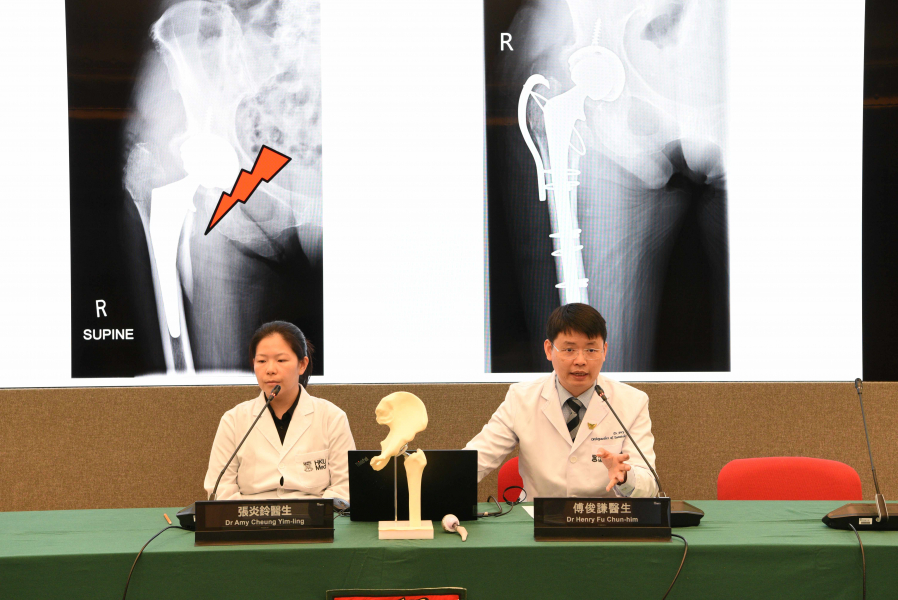
Dr Henry Fu Chun-him, Clinical Associate Professor and Chief of the Division of Joint Replacement Surgery, Department of Orthopaedics and Traumatology, School of Clinical Medicine, HKUMed, said, ‘The robotic arm allows the direction and depth of the acetabular cup placement to be executed in accordance with preoperative planning, achieving angular precision down to 2 degrees and depth accuracy within 2mm.’
Six‑year local data confirms safety advantages of robotic hip replacement
The research team reviewed the results of 553 primary total hip replacement surgeries performed in Queen Mary Hospital and the Duchess of Kent Children's Hospital at Sandy Bay Joint Replacement Centre between 1 January 2019 and 31 December 2024. These included 311 robotic total hip replacements and 242 conventional total hip replacements. The rate of reoperation within 30 and 90 days after surgery was lower for the robotic total hip replacement.
Dr Fu added, ‘Early reoperations after total hip replacement are devastating. With robotics, the rate of reoperation at 90 days is only 0.6%.’ In cases requiring reoperation in the robotic group, all procedures were done in a closed manner without the need for surgical reopening. In contrast, the conventional group had a 2.5% reoperation rate due to periprosthetic fractures and wound infections, requiring surgical reopening and resulting in prolonged recovery times.
While robotic procedures were associated with an overall increase in operative time of 14 minutes, the team observed a clear learning‑curve effect, with surgical times progressively approaching those of conventional manual procedures.
Growing utilisation of robotic surgery
HKUMed Department of Orthopaedics and Traumatology was the first in Hong Kong to utilise robotic arm technology for joint replacement surgery in public hospitals, beginning in January 2019.
Dr Amy Cheung Yim-ling, Honorary Clinical Assistant Professor and Deputy Division Chief of the Division of Joint Replacement Surgery of the same department, said, ‘The utilisation of robotics for total hip replacement in Queen Mary Hospital and the Duchess of Kent Children' s Hospital at Sandy Bay has risen steadily from 32% in 2019 to 85% in 2025. In the local public sector, robotic procedures now account for 49% of total hip replacement surgeries.’
About the research team
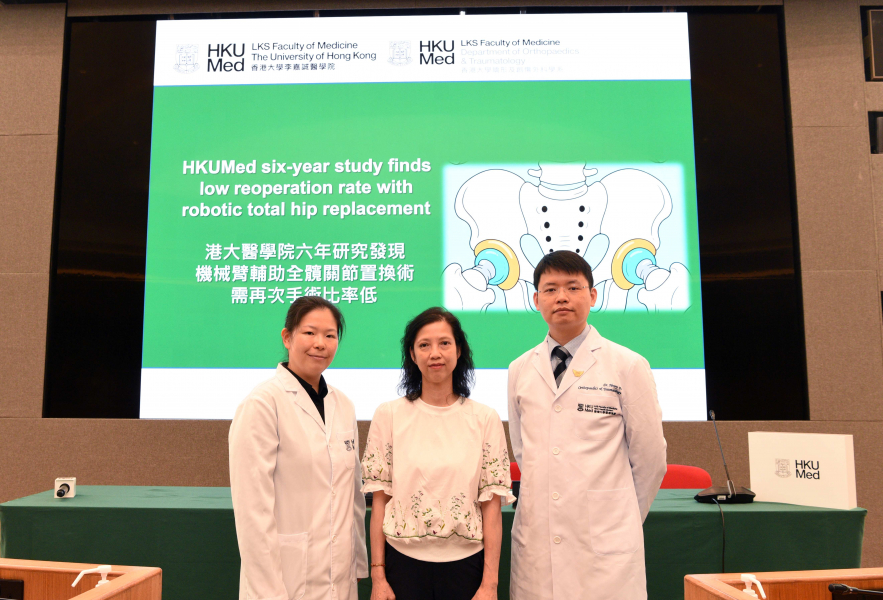
The research was led by Dr Henry Fu Chun-him, Clinical Associate Professor and Chief of the Division of Joint Replacement Surgery, Department of Orthopaedics and Traumatology, School of Clinical Medicine, HKUMed. Other team members include Francis Fong, HKUMed MBBS student; and Dr Amy Cheung Yim-ling, Dr Michelle Luk Hilda, Dr Thomas Leung Ka-chun, Dr Lawrence Lau Chun-man, Dr Chan Ping-keung and Professor Chiu Kwong-yuen, all from the same department.
Acknowledgements
The research received support from the Tam Shiu Charitable Trust, to acquire the robotic arm assisted surgical system.
Media enquiries
Please contact LKS Faculty of Medicine of The University of Hong Kong by email (medmedia@hku.hk).

 Facebook
  HKU IOS App
  HKU Android App
  Social Media and Apps